Overview of our proposed pipeline.
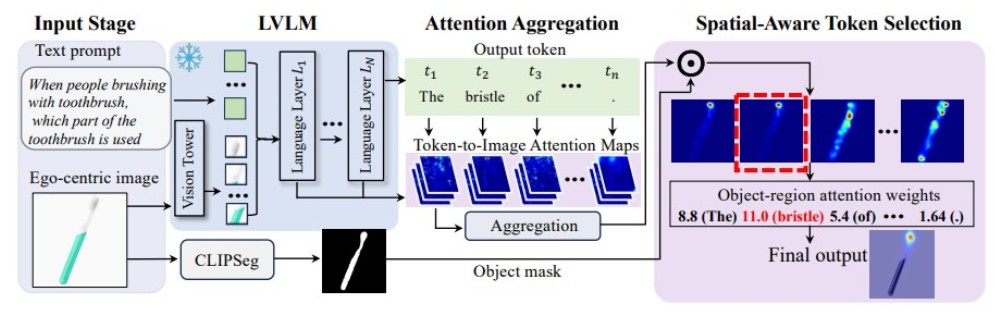
Given an egocentric image and an action text prompt, TokAG extracts output tokens \(\{t_1, t_2, \ldots, t_N\}\) from the language layers of a frozen LVLM. For each token \(t_i\), token-to-image attention maps are aggregated across all selected layers \(\mathcal{L}\) and attention heads \(\mathcal{H}\): \[ A_i = \frac{1}{|\mathcal{L}||\mathcal{H}|} \sum_{l \in \mathcal{L}} \sum_{h \in \mathcal{H}} A_{i}^{l,h}. \] Using object masks \(M_k\) generated by CLIPSeg, TokAG computes an object-region attention score for each token by measuring how strongly its attention falls inside the target object regions: \[ s_i = \sum_k \frac{\sum_{p} A_i(p) M_k(p)}{\sum_{p} M_k(p)}. \] The token with the highest score is selected, \(t^* = \arg\max_i s_i\), and its object-region attention heatmap becomes the final affordance grounding prediction.
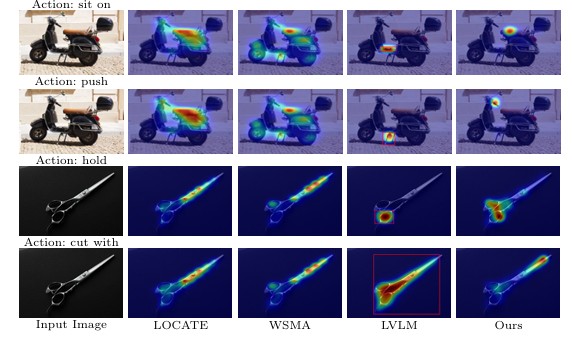
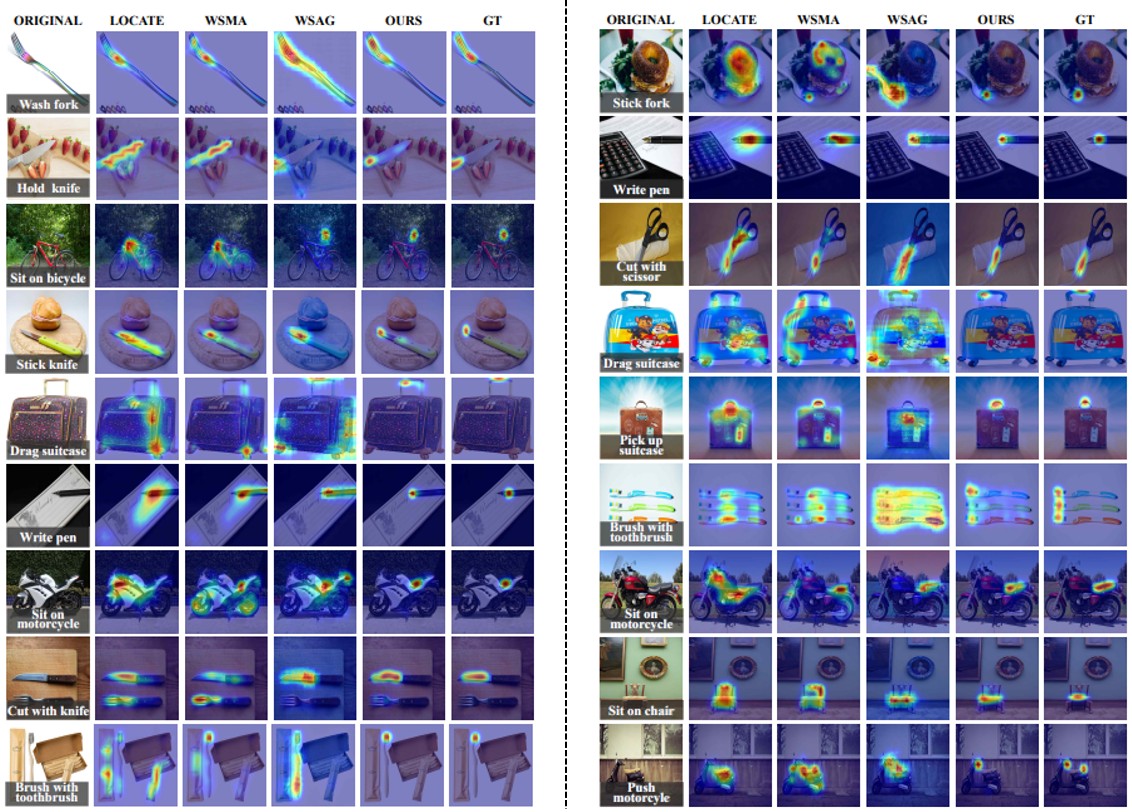
Here are some qualitative results.
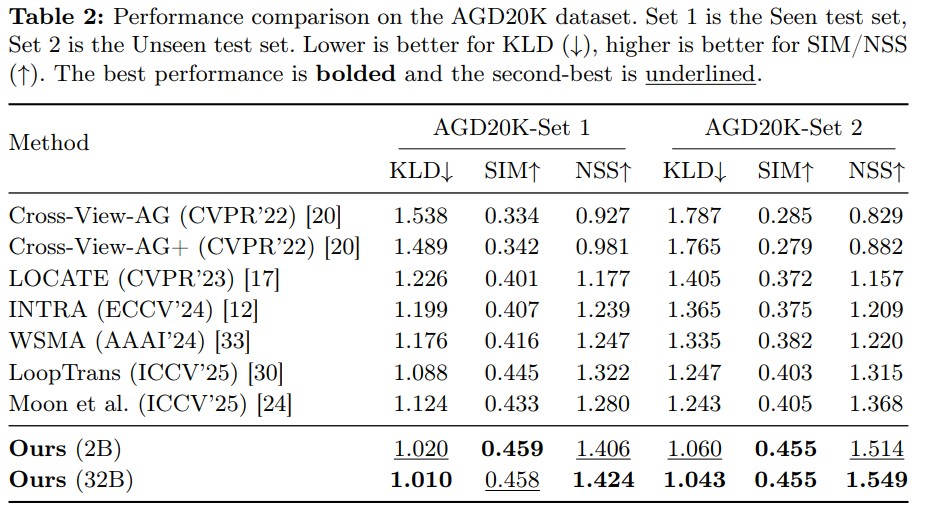
Here are the experiment results in zero-shot affordance grounding.
@inproceedings{lee2026tokag,
  title     = {Token-Based Affordance Grounding with Large Vision-Language Models},
  author    = {Lee, Seung il and Lei, Qinqian and Xu, Daguang and Yang, Dong and Tan, Robby T. and Chen, Yixin and Wang, Bo},
  booktitle = {In Proceedings of the European Conference on Computer Vision (ECCV)},
  year      = {2026}
}